The Competition Commission of India (CCI) today slapped a Rs 630-crore penalty on real estate giant DLF for trampling on the rights of apartment allottees — the single-largest amount slapped by any regulatory watchdog in the country. DLF has been accused of ripping off those who bought into Belaire — a tony, high-rise condominium in Gurgaon. The company has been charged with unilaterally changing the scope of the project midway, raising money from clients without statutory approvals and denying customers the right to equitable compensation while slipping on delivery schedules. The commission, which formally started work only last year, upheld the charge that DLF had abused its position of dominance in the country’s real estate market by foisting provisions in the buyers’ agreement that were loaded against its clients. The commission chose an interesting way to decide on the penalty. It calculated the penalty at 7 per cent of the average turnover of DLF in the three preceding years. The average for the three years between end-March 2009 and 2011 was estimated at Rs 9,006.27 crore. Seven per cent of this sum came to Rs 630 crore. The CCI had imposed a penalty for similar abuse of market dominance on the National Stock Exchange a month ago. However, the penalty then was only Rs 5 crore. This is a hefty penalty and a strong statement from CCI. The Belaire project was floated in August 2006 and initially supposed to have five towers of 19 floors each with a provision for 368 residential units. The project, spread over 6.6 acres, was to have been completed in 36 months. The apartments — each costing well over Rs 2 crore — aren’t likely to be handed over before October this year. Without consulting the apartment allottees, DLF arbitrarily raised the number of floors at Belaire to 29 from 19, which inordinately delayed the project. The numbers of floors were raised by compressing the common area. The allottees were denied the right to claim any reduction in the price on that account. DLF also included in the buyers’ agreement Clause 32 that permitted it to “abrogate all that has been promised to the allottee”. This clause allowed DLF to amend or change annexure to the buyers’ agreement. The abuse of its dominant position in the real estate industry — an aspect covered by clause 4 of the Competition Act - became a nub of contention. DLF argued that there were many competitors in the market and it, therefore, could not be accused of abusing its dominance. The commission, however, used a variety of statistics and assertions that DLF itself had made in several documents, including its annual report, to establish that it straddled the totem pole in the real estate business. The DLF stock plunged almost 6 per cent to Rs 189 on the Bombay Stock Exchange yeterday. |
Wednesday, August 17, 2011
DLF penalty in Gurgaon apartment case


Tuesday, August 16, 2011
Rupee trade with smaller nations in Chinese way
Indian exporters to developing countries are keen on rupee-denominated trade to guard against the uncertainties of a volatile dollar and euro.
A fluctuating dollar following a downgrade of US credit rating by Standard & Poor’s has prompted exporters, especially those selling high-value engineering products or construction services to Africa, Central Asia and Latin America, to seek rupee-denominated trade. The Chinese government is pursuing this strategy.
Dollar and euro fluctuations are affecting exporters & causing a great uncertainty and erosion in realisations. No amount of foreign exchange hedging helps these days.
The dollar’s value is expected to fall against currencies such as the rupee and the Chinese currency Renminbi after the US rating rap. The Renminbi has appreciated 0.72 per cent to an all-time high in just four days after S&P cut the US debt rating from “AAA” to “AA+”.
It is feared that central banks all over the world will now look for ways to reduce their dollar holdings. They cannot do so overnight or even in the course of a year as the only competing currency — euro — is also going through troubled times because of the near bankruptcy in many euro zone countries.
Currency traders say they expect the rupee to come down from Rs 45 to the dollar to about Rs 40 by the middle of next year. Such a fall in value will mean an Indian exporter contracting to sell, say cars to Kenya at $10,000 apiece taking the dollar value at Rs 45, could get 12.5 per cent less in rupee terms.
Around 35-40 per cent of India’s exports are with the developing world, while 65-70 per cent are with the US, Europe, Japan and West Asia.
However, the 82 per cent jump in exports in June came mainly from the non-dollar, non-euro countries.
Sanjay Budhia, chairman of the CII national committee on exports and managing director of Patton Group, said, “Rupee denominated trade will take out the uncertainty in realisations.”
Exporters want India’s Exim Bank to give rupee debt to developing countries against which they can export profitably — just as China’s banks are extending Renminbi-denominated loans to Indian electricity generating companies to buy Chinese equipment.
However, as per former Fieo president A. Sakthivel, “Rupee trade does not help us much as most of our trade is with US and Europe. If we try to go for bilateral currency trade, accepting payment in local currencies of South America, Africa will be a problem.”
Many economists are also in favour of rupee trading. D.K. Joshi, chief economist of Crisil, said, “The Chinese are doing trade deals in Renminbi with many countries and we should do the same.”
Friday, August 12, 2011
Magic Card
A very new kind of Plastic card has launched in India recently. Public sector bank IDBI recently announced the launch of Magic Card, which encompasses the features of a Debit Card with a credit limit, that charges much less than a regular credit card for salaried people only!
IDBI is the first bank in India to launch such kind of product.
With the increasing use of plastic money, this kind of card may prove useful for the bank to acquire good business.
Features of Magic Card:
§ The card incorporates the features of Debit Card as well as Credit Card work’s as a debit card till the account holder has balance in his account, once balance is over it will start functioning as a credit card.
§ The card will be offered to eligible salary account holders of IDBI Bank and the credit limit would be a multiple of the monthly salary earned by the cardholder.
§ There is no processing fee for the card, neither any charge’s for cash withdrawal, with a daily limit of
Rs50, 000/- from any bank ATM or purchase transaction.
Wednesday, August 10, 2011
Buffett flays downgrade

Legendary investor Warren Buffett has said that the downgrade did not make any sense at all.
Buffett is a major shareholder in S&P’s rival rating agency Moody’s, which continues to maintain a “AAA” rating on the US.
S&P Report made them poor
The global markets have been spiraling, thanks to the US debt crisis. Not only are we the commoners losing thousands of our hard-earned money, the country's richest aren't any much better off either.

According to this infographic made by our expert, Deepak Shenoy, the Ambani brothers have been the biggest losers with Anil Ambani's kitty getting lighter by a whooping Rs 7.6K crore closely followed by Mukesh Ambani who suffered a Rs 7.3K crore loss. IT bigwig Azim Premji, chairperson of Wipro Ltd, lost almost Rs 6.6 K crore
The BSE Sensex ended 1.7 per cent lower in trade today, led by losses in software exporter Infosys, after Standard & Poor's downgrade of the U.S. sovereign debt rating triggered a flight from risky assets.
ADAG's Anil Ambani was the highest loser in today's market slide with a loss of Rs 7,630 crore.
India's richest man, Mukesh Ambani with a $27 billion networth, and with a promoter stake of 146.39 crore shares of Reliance Industries, lost a total of Rs 7,349 crore during the market mayhem.
Telecom baron Sunil Mital who owns 36% in Bharti Airtel (the promoter shareholding includes Singtel) lost about Rs 4,531 crore.
The IT sector witnessed the maximum downslide with the sector ending 4.3 per cent. IT bellwether Infosys Technology ended 4.73 per cent lower making its founders poorer by Rs 3,173 crore.
Meanwhile, Wipro's promoter Azim Premji who holds 194.6 cr. shares of Wipro saw his market value fall by Rs 6,626 crore. The shares tanked 2.54 per cent on the BSE.
Others in the list include, HCL promoter Shiv Nadar, who with a total of 44 crore shares in the company lost Rs 2,962 crore, DLF promoter KP Singh, whose market value fell by Rs 4,645 core, and the Jindals who saw their shares tank by Rs 2,608 crore.

Here's a look at how much their market value has changed during the week:
Globally, even the world's richest man, Carlos Slim, lost $8 billion this week (Aug 1-8), while steel magnate and Britain's richest Indian Lakshmi Mittal lost £ 2.16 billion.
Bill Gates and Warren Buffet, however, have been luckier with their portfolios; Gates's Microsoft Corp. dropped 5.3% this week before Friday, while Buffett's Berkshire Hathaway Inc. slid 4.3%.
Tuesday, August 9, 2011
S&P Impact
Standard and Poor’s global rating has downgraded US long term debt rating from “AAA” to ‘AA+” citing mainly two reasons.
1) US fiscal consolidation plan falls sort of what would be necessary to stabilize medium term debt dynamics.
2) US governance & policy making “less stable, less effective & has predictable “.
From 1917, this is the first time the health of the US fiscal policy is in question.
The US sovereign downgrade was not entirely unexpected by markets the world over. More
importantly, this rating action, albeit delayed, is yet another sign that the fall-out from the global financial crisis will be felt for many years to come.
The loss of AAA rating is likely to have a gradual and long-winding impact for the US’ standing in the world, the dollar's status, and the global financial system over the long-term.
Over the longer-term, global economic equations are set to shift significantly with concerted
efforts towards working out a new, alternative global reserve currency and likely gradual change in global reserves’ asset allocation mix towards gold and other commodities, high-potential emerging markets.
Already, Chinese policy makers are discussing ways to diversify the country's foreign exchange holdings away from dollars (one-third of its reserves) and how to encourage Chinese companies to invest some of the foreign reserves overseas.
However, US treasuries’ status as a “relative” safe haven investment is likely to continue over the medium term, given its stature as the deepest and liquid sovereign bond market.
The S&P action may trigger an automatic reaction from global markets, especially as the move coincides with the weakening global economy and spreading contagion because of sovereign debt issues in Euro zone.
The extra uncertainty could prolong the latest slide in equity prices. Heightened risk-aversion is likely to play out in the coming weeks and months.
While US bond yields are likely to spike in the short-term, they would not sustain at higher levels for long, since, once the dust settles, attention will once again turn back to the economic fundamentals, which are certainly consistent with low Treasury yields.
The US dollar will weaken owing to the rating downgrade and the perceived riskiness, causing EM currency appreciation as well as higher foreign inflows in Emerging Markets, including India, through both FII and FDI routes.
However, in case of any sharp currency movements, I expect RBI to step in and intervene in the currency market to limit the extent of INR appreciation.
The negative outlook assigned on the AA+ rating, will most likely ensure a tighter fiscal policy
regime in the US. It will be interesting to watch the trade-off between tighter US fiscal policies in contrast with a much looser monetary policy stance.
The interplay of these factors and their impact on US growth and inflation would determine the likelihood, timing as well as nature of further quantitative easing measures.
Now, the probability of a monetary expansion (in any form) in the US looks low in the near term but cannot be entirely ruled out in 2012.
RBI’s hawkish monetary stance is also likely to moderate going ahead given heightened global
uncertainty levels, weaker commodity prices and moderating domestic economic growth.
India will benefit from lower commodity prices in the long-term which will help in tacking inflationary challenges largely. This will be incrementally positive for Indian bond markets.
In addition, India is likely to be a beneficiary in terms of fund flows – both FDI & FII – in the medium-to-long term. Overall, while the short-term impact of the latest S&P action will be jittery for markets across the world, the eventual impact will be positive for Indian markets.
Disclaimer- This article is based on various data available on the internet. The author or this blog (www.yoursweetmoney.blogspot.com) must hold responsible for any wrong decision. You are hereby requested to crosscheck this article and content with your financial expert.
S&P: Asia would be hit harder by a second global crisis
A new global financial crisis would hit Asia harder than the last one, especially nations heavily exposed to offshore markets or still repairing budgets from the 2008-2009 crisis, credit ratings agency Standard and Poor's said on Monday.
The agency, which incurred Washington's wrath at the weekend by cutting its AAA rating by a notch to AA+, said it was not predicting a rerun of the credit crisis that crippled markets and tipped the world economy into recession three years ago.
But it warned of more sovereign downgrades in Asia next time around, if its assumptions turned out to be wrong.
"If a renewed slowdown comes, it would likely create a deeper and more prolonged impact than the last one," S&P said in a statement.
"The implications for sovereign creditworthiness in Asia-Pacific would likely be more negative than previously experienced, and a larger number of negative rating actions would follow. We wait to see."
S&P said it assumed Europe's debt crisis and Washington's debt problems were unlikely to lead to "abrupt dislocations" in the financial systems and economies of major developed nations.
On that basis, it added, its historic downgrade of the U.S. credit rating would have no immediate knock-on impact on sovereign borrowers in the Asia-Pacific.
It cited the Asia Pacific region's sound domestic demand, relatively healthy corporate and household sectors, plentiful external liquidity and high savings rates -- though it listed New Zealand, Japan and Vietnam as exceptions to this.
The S&P statement took on a much darker tone when considering the possibility that its assumptions were too rosy, noting that Asia still relied heavily on exports to the West.
"Given the interconnectivity of the global markets, an unexpectedly sharp disruption in developed-world financial markets could change the picture," it said, noting that the U.S. and European economies could again contract or stagnate.
"In this scenario, the experience of the global financial crisis of 2008-2009 shows that export-dependent economies with large exposures to the U.S. and/or Europe would feel the most pronounced economic impacts," S&P said.
"It's not likely things would be very different this time."
The agency listed those countries particularly vulnerable to disruptions in offshore capital markets as Pakistan, Sri Lanka, Fiji, Australia, New Zealand, South Korea and Indonesia.
It also said several nations, again including New Zealand, were also still repairing their government finances and could be more constrained in responding to a fresh global crisis.
"The adverse impact on Asia Pacific in that scenario would likely require governments to use their balance sheets to support their economies and financial sectors once again," S&P said.
"And in our opinion, most governments would promptly oblige. But some of them continue to bear the scars of the recent downturn -- the fiscal capacities of Japan , India, Malaysia, Taiwan and New Zealand have shrunk relative to pre-2008 levels."
Monday, August 8, 2011
Lakshmi Mittal loses 2.16 billion pounds following market crash
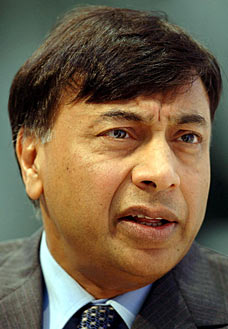
Steel magnate and Britain's richest man Lakshmi Mittal has lost 2.16 billion pounds (around Rs.158648328000/-) within a week following the global stock market crash.
The share price his company Arcelor Mittal, of which he owns 40.83 per cent, plummeted 18.7 percent this week reducing the value of his fortune to 9.7 billion pounds, the Daily Mail reports.
The non-resident Indian employs 320,000 people in 60 countries and lives in Bernie Ecclestone's former home in Kensington that he bought for a reported 57million pounds in 2004.
The catastrophic six days for stocks on both sides of the Atlantic has increased fears that this meltdown will lead to a dreaded double-dip recession.
Courtesy- ANI
Saturday, August 6, 2011
For first time, US loses AAA credit rating
For the first time in history, credit rating agency Standard & Poor's has downgraded America's top-notch credit rating, stripping the world's largest economy of its prized AAA status.
'We have lowered our long-term sovereign credit rating on the United States of America to 'AA+' from 'AAA,'' S&P said Friday in a stunning blow to the country, that has enjoyed the top rating for 70 years, and its political leadership".
In July, S&P, one of the three major agencies that assign grades the credit of companies and governments, placed the US rating on 'CreditWatch with negative implications' as the debt ceiling debate devolved into partisan bickering.
To avoid a downgrade, S&P said the US needed to not only raise the debt ceiling, but also develop a 'credible' plan to reduce the federal debt by at least $4 trillion over the next decade.
Earlier this week, Congress instead passed a plan to reduce the debt by at least $2.1 trillion.
In its report Friday, S&P ruled that the US fell short: 'The downgrade reflects our opinion that the ... plan that Congress and the Administration recently agreed to falls short of what, in our view, would be necessary to stabilise the government's medium-term debt dynamics.'
S&P also cited dysfunctional policymaking in Washington as a factor in the downgrade. 'The effectiveness, stability, and predictability of American policymaking and political institutions have weakened at a time of ongoing fiscal and economic challenges.'
The other rating agencies, Moody's and Fitch, have said they have no immediate plan to downgrade the US credit rating, giving the government more time to make progress on debt reduction.
The split verdict limits the impact of the S&P downgrade, as many consequences would be set off only by a reduction by two agencies, the New York Times said.
However, the lowering of the country's rating could rattle confidence and raise borrowing costs for the government and consumers, impeding the already fragile recovery, it said.
The announcement by S& P came after a week of turmoil on Wall Street not seen since the days of the financial crisis. After plunging around 5 percent Thursday, stocks bounced up and down Friday and closed relatively flat.
Friday, August 5, 2011
Per capital income of Inida
Per capital income of India has jumped over two-folds between 2004-05 and 2010-11 to touch Rs 54,835 per annum (Approx 1227.2829 USD), minister of state for statistics and programme implementation Srikant Jena informed Parliament.
Dual rates for diesel
The government may introduce dual rates for diesel — with the price of the fuel higher in cars and commercial power compared with the price for truckers and farmers — to prevent its misuse.
During a parliamentary debate on the price rise, Opposition leaders asked finance minister Pranab Mukherjee if the government would withdraw subsidy benefits on diesel used by premium cars and commercial users such as telecom tower companies, malls and restaurants.
“We can accept your suggestion and work out a mechanism so that the (privileged) sections are not subsidised,” Mukherjee said.
Of the total diesel sold, passenger cars, 8 per cent by power plants, 12 per cent by agriculture and 37 per cent by trucks used 15 per cent.
On Sunday, Mukherjee said the government was keen to free the prices of diesel and cooking gas (LPG) to keep its finances under control.
Diesel is the main transport fuel used by trucks and buses. While petrol rates have recently been linked to market prices, the government gives a subsidy of Rs 6.08 per litre on diesel.
Subsidised diesel is also used in irrigation pumps, agriculture equipment and power generators at malls and telecom towers.
Recently, automakers such as Maruti Suzuki and General Motors and even premium carmakers such as Audi and BMW have introduced diesel variants to meet growing demand from consumers.
Mukherjee’s comments on the dual pricing of diesel affected the Mahindra & Mahindra (M&M) counter, shares of which plummeted 4.45 per cent, or Rs 31.65, to Rs 679.25.
“M&M may be impacted the most if this were to happen as most of its utility vehicles are run on diesel,” an auto analyst said.
However, as per Pawan Goenka, president, automotive and farm equipment sector at M&M, the company would not be affected significantly in terms of demand, as customers were unlikely to shift to petrol vehicles in a hurry.
He, however, admitted that a hike in excise duties on diesel cars might impact sales.
Manage your Insurance Portfolios properly
While many individuals believe they are on a firm wicket about their investments (like mutual funds, fixed deposits, small savings schemes, etc), they are usually tentative about their insurance needs.
For one, insurance has many options often confusing the individual.
Secondly, 'insurance awareness' among individuals is very low, which when combined with wrong selling leaves them even more confused.
At a level, managing your insurance portfolio is a relatively straightforward task. It is all about breaking the process down into simpler steps.
At a level, managing your insurance portfolio is a relatively straightforward task. It is all about breaking the process down into simpler steps.
Once you have the measure of these steps, you are home. Broadly, managing your insurance portfolio involves four steps:
Identify your needs:
Like with shopping when a well-defined list helps you focus on the task at hand and avoid venturing into unrelated avenues, drawing up an insurance list can have the same effect.
Identify your needs:
Like with shopping when a well-defined list helps you focus on the task at hand and avoid venturing into unrelated avenues, drawing up an insurance list can have the same effect.
To avoid being swayed by the plethora of insurance options, determine at the outset what you are looking for.
Broadly, the insurance seeker can have one of two needs----
Broadly, the insurance seeker can have one of two needs----
a) Life cover (through a term plan) or
b) Investment combined with life cover (through traditional endowment or a unit linked insurance plan).
Although the latter sounds like the convenient option, we recommend against it.
Going for this option will deprive you of the benefits of selecting the two options i.e. insurance and investment in isolation.
Going for this option will deprive you of the benefits of selecting the two options i.e. insurance and investment in isolation.
In other words selecting life cover or investment separately is more prudent than selecting a combination of both.
It is advisable to maintain that over the long-term, you will be better off separating these two objectives.
Quantify your needs:
Once you have decided why you need insurance it’s time to answer the question - how much insurance do I need?
Quantify your needs:
Once you have decided why you need insurance it’s time to answer the question - how much insurance do I need?
Of course, the answer to this question will depend on whether you wish to opt for a life cover or an investment plan.
The reason is that these two questions will have very different answers.
To understand this better let us take the first scenario i.e. you want a life cover. Typically, this will involve planning for all future liabilities and commitments as also setting up a contingency fund.
To understand this better let us take the first scenario i.e. you want a life cover. Typically, this will involve planning for all future liabilities and commitments as also setting up a contingency fund.
Those familiar with the jargon know that we are referring to the Human Life Value over here.
On the other hand, if instead of a pure risk cover, you want to opt for an investment plan, then you will first have to identify the investment objective like retirement or child's education for instance.
On the other hand, if instead of a pure risk cover, you want to opt for an investment plan, then you will first have to identify the investment objective like retirement or child's education for instance.
Once you have done that, then you will have to quantify the investment amount to answer the question - how much money do I want to save for my retirement?
Alternatively - how much money do I want to save for my child's education?
Selecting your insurance advisor:
As we mentioned at the beginning, one reason why insurance has turned out to be more complicated than necessary is because of the quality of insurance advice.
Selecting your insurance advisor:
As we mentioned at the beginning, one reason why insurance has turned out to be more complicated than necessary is because of the quality of insurance advice.
Selling insurance, as you are aware can be very remunerative. Not surprisingly, the advisor is often biased in favor of insurance products that garner the highest commissions.
Therefore, you have to be sure that your insurance advisor is honest and competent.
If you cannot ascertain this easily, insist on references whenever possible.
If you cannot ascertain this easily, insist on references whenever possible.
Check his recommendations by asking for comparisons across insurance companies over various parameters.
Understand why he is recommending one insurance plan over another. In addition, if he is making claims that seem outlandish to you, do not hesitate to either take it down in writing from him or get a confirmation from a company official.
Another problem with insurance advisors is that many of them are mutual fund agents on the side.
Understand why he is recommending one insurance plan over another. In addition, if he is making claims that seem outlandish to you, do not hesitate to either take it down in writing from him or get a confirmation from a company official.
Another problem with insurance advisors is that many of them are mutual fund agents on the side.
While, this by itself does not pose a problem, clients often complain of how their insurance advisor is at times not keen on selling life insurance and invariably makes a pitch for mutual funds.
The solution to this problem lies in identifying your needs. If you have decided to opt for a life cover for instance, make sure your insurance advisor gets the point.
The solution to this problem lies in identifying your needs. If you have decided to opt for a life cover for instance, make sure your insurance advisor gets the point.
If he still insists on selling other products then it is time to re-evaluate whether he is the right insurance advisor for you.
At times, having sold an insurance policy, the insurance advisor is no longer interested in servicing the same.
At times, having sold an insurance policy, the insurance advisor is no longer interested in servicing the same.
References can play a critical role in weeding out such advisors.
Conduct a review regularly:
Like all other long-term activities, you must monitor your insurance portfolio closely to ensure that you are on track to achieve your objectives.
Conduct a review regularly:
Like all other long-term activities, you must monitor your insurance portfolio closely to ensure that you are on track to achieve your objectives.
For instance, if you have opted for a life cover (in line with your Human Life Value), then you will have to keep a close eye on your liabilities and financial commitments.
If there is a discernible upward revision, then your existing life cover may not prove sufficient and you may have to consider taking additional cover.
If there is a discernible upward revision, then your existing life cover may not prove sufficient and you may have to consider taking additional cover.
The solution to this problem is to opt for a slightly higher cover at the outset; since pure risk plans are relatively cheap, it will not prove to be expensive.
On the same lines, if you have opted for an investment plan for your child's education for instance, then at periodic intervals (e.g. annually) ensure that your investment plan is on course to achieving the desired result.
On the same lines, if you have opted for an investment plan for your child's education for instance, then at periodic intervals (e.g. annually) ensure that your investment plan is on course to achieving the desired result.
Again, if there is a discernible deviation, it is time to re-evaluate your investment.
By now, hope you have realized that managing your insurance portfolio is not as difficult as it appears.
By now, hope you have realized that managing your insurance portfolio is not as difficult as it appears.
Like any other activity it involves taking decisions, implementing them and monitoring the results closely.
Of course, your insurance advisor will play a key role over here, which is why it is important to ensure that he is honest and competent.
Subscribe to:
Posts (Atom)